Atemschutzmaßnahmen: Unterschied zwischen den Versionen
Zur Navigation springen
Zur Suche springen
Keine Bearbeitungszusammenfassung |
Keine Bearbeitungszusammenfassung |
||
| Zeile 65: | Zeile 65: | ||
! Anwendung !! Farbe & Schutzwirkung | ! Anwendung !! Farbe & Schutzwirkung | ||
|- | |- | ||
| Partikel | | Partikel: Stäube, Rauch & Nebel || <span style="color: #ff9900;">P1</span>: Mindergiftige feste Stoffe<br><span style="color: #ff9900;">P2</span>: Mindergiftige feste & flüssige Stoffe<br><span style="color: #ff9900;">P3</span>: Giftige feste & flüssige Stoffe | ||
|- | |- | ||
| Organische Gase & Dämpfe || <span style="color: #b95031;">A1</span>: Organische Gase & Dämpfe (Siedepunkte über 65 °C)<br><span style="color: #b95031;">Ax</span>: Organische Gase & Dämpfe (Siedepunkte unter 65 °C) | | Organische Gase & Dämpfe || <span style="color: #b95031;">A1</span>: Organische Gase & Dämpfe (Siedepunkte über 65 °C)<br><span style="color: #b95031;">Ax</span>: Organische Gase & Dämpfe (Siedepunkte unter 65 °C) | ||
| Zeile 81: | Zeile 81: | ||
! Anwendung | ! Anwendung | ||
|- | |- | ||
| Partikel | | Partikel: Stäube, Rauch & Nebel (<span style="color: #ff9900;">P</span>) | ||
|- | |- | ||
| Organische Gase & Dämpfe | | Organische Gase & Dämpfe (<span style="color: #b95031;">A</span>) | ||
|- | |- | ||
| Anorganische Gase & Dämpfe | | Anorganische Gase & Dämpfe (<span style="color: #707070;">B</span>) | ||
|- | |- | ||
| Saure Gase, Schwefeldioxid & Hydrogenchlorid | | Saure Gase, Schwefeldioxid & Hydrogenchlorid (<span style="color: #dcff1e;">E</span>) | ||
|- | |- | ||
| Ammoniak & organische Ammoniak-Derivate | | Ammoniak & organische Ammoniak-Derivate (<span style="color: #00b70e;">K</span>) | ||
|- | |- | ||
| Kohlenstoffmonoxid | | Kohlenstoffmonoxid (<span style="color: #000000;">CO</span>) | ||
|} | |} | ||
{| class="wikitable mobilestatements" style="width: 100%;" | {| class="wikitable mobilestatements" style="width: 100%;" | ||
Version vom 25. Juli 2023, 23:18 Uhr
Ein besonderes Risiko besteht bei der Altbausanierung.
Ein guter Schutz ist bei Schimmelsanierung und Schleifarbeiten unabdingbar.
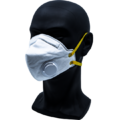
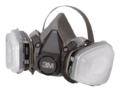
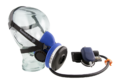
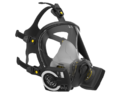
Atemschutzgeräte
 |
|
 |
|
 |
|
 |
|
|
|
|
|
Filterkennzeichen
| Anwendung | Farbe & Schutzwirkung |
|---|---|
| Partikel: Stäube, Rauch & Nebel | P1: Mindergiftige feste Stoffe P2: Mindergiftige feste & flüssige Stoffe P3: Giftige feste & flüssige Stoffe |
| Organische Gase & Dämpfe | A1: Organische Gase & Dämpfe (Siedepunkte über 65 °C) Ax: Organische Gase & Dämpfe (Siedepunkte unter 65 °C) |
| Anorganische Gase & Dämpfe | B: z. B. Chlor, Schwefelwasserstoff, Blausäure, aber keinen Schutz gegen Kohlenstoffmonoxid! |
| Saure Gase, Schwefeldioxid & Hydrogenchlorid | E: Schwefeldioxid, Chlorwasserstoff & andere saure Gase |
| Ammoniak & organische Ammoniak-Derivate | K: Ammoniak & organische Ammoniak-Derivate |
| Kohlenstoffmonoxid | CO: Kohlenstoffmonoxid |
| Anwendung |
|---|
| Partikel: Stäube, Rauch & Nebel (P) |
| Organische Gase & Dämpfe (A) |
| Anorganische Gase & Dämpfe (B) |
| Saure Gase, Schwefeldioxid & Hydrogenchlorid (E) |
| Ammoniak & organische Ammoniak-Derivate (K) |
| Kohlenstoffmonoxid (CO) |
| Farbe & Schutzwirkung |
|---|
| P1: Mindergiftige feste Stoffe P2: Mindergiftige feste & flüssige Stoffe P3: Giftige feste & flüssige Stoffe |
| A1: Organische Gase & Dämpfe (Siedepunkte über 65 °C) Ax: Organische Gase & Dämpfe (Siedepunkte unter 65 °C) |
| B: z. B. Chlor, Schwefelwasserstoff, Blausäure, aber keinen Schutz gegen Kohlenstoffmonoxid! |
| E: Schwefeldioxid, Chlorwasserstoff & andere saure Gase |
| K: Ammoniak & organische Ammoniak-Derivate |
| CO: Kohlenstoffmonoxid |
Zu Lernfeld 1 zurück
